

Estimating
Drywall estimating software: price jobs faster
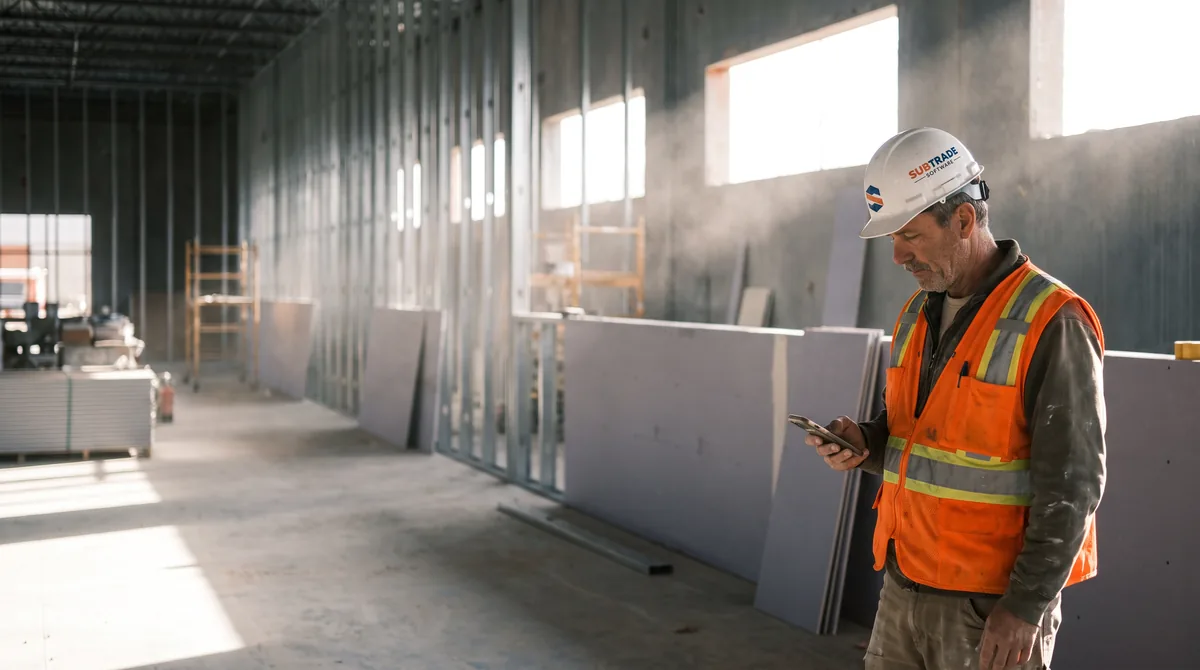
Every drywall contractor has the same two problems at bid time: not enough hours in the day, and not enough confidence in the number.
You get the invite Tuesday. It closes Friday. There are four other bids in your pile, the drawings came as a 180-page PDF, and the last time you priced a job like this you can't remember whether you made money on it or just survived it.
So you do what everyone does. You pull the last similar job, adjust it by feel, add a bit for the ceiling heights, and send it. Sometimes it works. Sometimes you find out in month three that your board rate was optimistic and the taping scope ate your entire margin.
Estimating software doesn't make you a better estimator. What it does is make your own history usable — so the number you send Friday is based on what your crews actually did, not what you hope they'll do.
We built this into SubTrade at Quality Gypsum Services in Calgary because we were tired of bidding out of a spreadsheet that only one person understood.
Why drywall estimating is its own problem
Generic construction estimating software treats drywall like a line item. It isn't. It's a stack of interlocking scopes that each move at their own rate:
- Framing — steel stud gauge, spacing, height, deflection track, backing
- Board — type (Type X, moisture resistant, abuse resistant, shaftliner), thickness, layers, orientation
- Taping and finishing — Level 0 through Level 5 under GA-214 levels of finish, and the gap between Level 4 and Level 5 is a real number, not a rounding error
- Insulation, firestopping, and acoustic sealant — often yours, often forgotten at bid
- Ceilings and bulkheads — where hours disappear
- Access, height, and phasing — scaffold, lifts, occupied buildings, night work
A generic tool gives you a square footage and a unit price. A drywall-aware system lets you price each of those scopes separately, at your own rates, and shows you which one is carrying the risk.
The three things that actually make estimating faster
1. Takeoff you don't redo three times
Most of the time in a bid isn't pricing — it's measuring. Digital takeoff on the PDF, with scaled measurements you can save and reuse, is where the hours come back. Measure the wall types once, tag them, and let the assemblies carry the material and labour behind them.
The gain compounds: when the addendum lands Thursday and half the partitions change, you're adjusting a tagged assembly instead of recounting the whole floor.
2. Assemblies built once, priced forever
An assembly is a wall type with everything behind it. "3-5/8" 20ga stud at 16" o.c., 5/8" Type X both sides, Level 4 finish, 10' high" should be one click that carries studs, track, screws, board, tape, compound, corner bead, and the labour hours for each. Build them against the actual standard — the Gypsum Association publishes GA-214 and the assembly references your specs will point to — so your assemblies and the architect's partition schedule speak the same language.
Build your assemblies once against your real specs and the bid becomes selection instead of arithmetic. This is where most estimators find they've been rebuilding the same wall from scratch for eight years.
3. Production rates from your own completed jobs
This is the part software can do that a spreadsheet can't.
National rate databases are a starting point, not an answer. Your crews aren't average. Your board rate on a 9-foot open commercial floor is nothing like your rate on an occupied hospital corridor with two-hour phasing.
If your field labour is captured properly — every hour coded to a job and a scope through time tracking — then your completed jobs become an estimating database. Board hung per man-hour. Feet of tape per man-day. Framing per linear foot at each height band. Real numbers from real crews, in your market.
That's the loop that makes estimating both faster and more accurate: bid, build, cost, feed the rates back into the next bid. Without job costing behind it, estimating software is just a fancier calculator. With it, every job you finish makes the next bid sharper. Our job costing tools are designed to close exactly that loop.
A practical estimating workflow for drywall subs
Here's the sequence that works, whether you're a two-crew shop or running thirty people.
Step 1 — Qualify before you estimate. Not every invite deserves your Thursday. Check the GC, the schedule, the payment history, the holdback terms, and whether the scope actually matches what you're good at. Alberta's prompt payment rules give you 7 calendar days after the GC gets paid — but only if the contract and the invoice are in order, so read the payment terms before you price the work, not after. CCDC 23, the Guide to Calling Bids and Awarding Contracts, is a useful benchmark for what a fair bid process should look like.
The fastest bid is the one you don't do.
Step 2 — Read the wall types page first. Before any measuring. The partition schedule tells you where the money and the risk are. Flag anything unusual — shaftwall, acoustic assemblies, high walls, Level 5 — immediately.
Step 3 — Take off by wall type, not by room. Tag and measure each partition type across the whole set. Faster, and it maps directly to your assemblies.
Step 4 — Apply your production rates by condition, not by average. Split ceiling heights. Split occupied vs. open. A single blended rate is how good estimators lose money on hard jobs and lose bids on easy ones.
Step 5 — Price the scopes you always forget. Firestopping. Acoustic sealant. Backing for millwork and TV mounts. Patching after other trades. Temporary protection. Cleanup and debris. Each one is small. Together they're a margin.
Step 6 — Qualify your bid in writing. Exclusions, assumptions, the finish level you priced, hoisting, access hours, and what triggers an extra. Half of the change orders you'll fight for later are won or lost on this page. Set it up so that when the scope moves, your change order management process has a baseline to point at.
Step 7 — Log what you assumed. When the job's done, compare assumed rates to actual. That review takes twenty minutes and is worth more than any estimating course.
What to look for in drywall estimating software
Cut through the demos with these:
- Does it hold your own production rates, by condition, or only a generic database?
- Can it pull actuals from completed jobs automatically, or do you type them in?
- Are assemblies editable by you without calling support?
- Does it handle finish levels as a real cost variable?
- Can you bid, then track the same job in one system — or does the estimate die at award? This is usually where GC platforms vs. software built for subs separate, since GC tools rarely carry a sub's estimate through to a sub's job cost.
- What happens on addendum day? Watch someone change a wall type in the demo and see how much rework it causes.
- Pricing — flat monthly beats per-project fees when you're bidding twenty jobs to win four.
That last point matters more than people expect. Estimating volume is high and win rates are low; software that charges per bid punishes you for doing the work.
The bigger picture
Faster estimating is nice. Estimating that gets more accurate every quarter is what changes the business.
The drywall contractors we see doing best aren't the ones with the slickest takeoff tool. They're the ones who closed the loop — where field hours feed job costing, job costing feeds production rates, and production rates feed the next bid. Three years in, they know their numbers cold, and they can bid tight without gambling.
SubTrade is built for that loop, by a commercial drywall contractor who needed it. See how it fits your shop with our drywall contractor software overview. It starts at $299/month CAD with a 14-day free trial and no credit card.
FAQ
What is drywall estimating software?
Software that handles digital takeoff, wall-type assemblies, and labour and material pricing for drywall scopes — framing, board, taping and finishing — so you can produce a bid without rebuilding the numbers by hand every time.
How is it different from generic construction estimating software?
Drywall-specific tools understand assemblies, finish levels, stud gauges, and height conditions as cost drivers. Generic tools give you a square foot price and leave the trade knowledge to you.
Can I use my own production rates?
You should insist on it. National averages are a starting point. The real advantage comes from feeding your completed jobs' actual hours back into your rates.
How much time does it save on a bid?
The biggest gains are on takeoff and on addenda. Tagged assemblies update when a wall type changes instead of being recounted, so revisions stop costing you an afternoon.
Do I need job costing too?
For the software to make your estimates more accurate over time, yes. Without actual costs coming back from the field, you're just recycling assumptions faster.
What does it cost?
SubTrade starts at $299/month CAD with a 14-day free trial and no credit card required. Watch for per-project or per-bid pricing elsewhere — it adds up fast at normal bidding volumes.
SubTrade runs time tracking, change orders, daily logs and progress billing on one plan. 14-day trial, no credit card.