

Getting started
What is a sub trade? A plain answer for construction
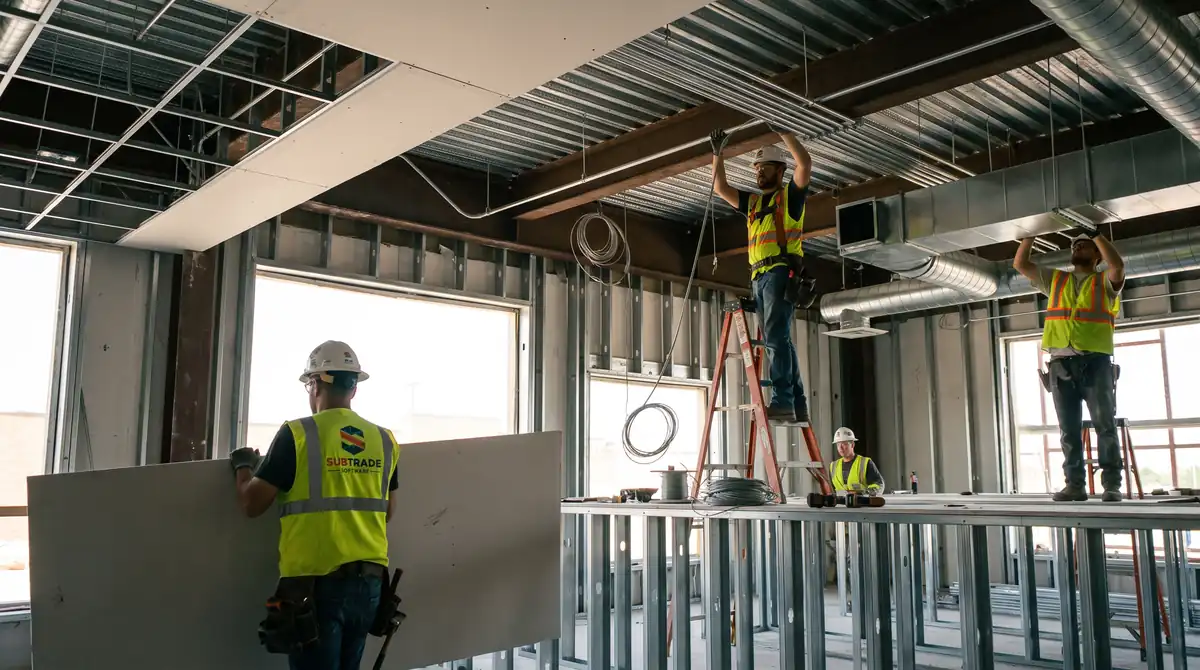
A sub trade is a specialty contractor hired to perform one defined scope of work on a construction project — drywall, electrical, mechanical, framing, painting — under contract to the general contractor rather than to the owner.
That's the whole definition. The confusion isn't really about the meaning. It's about the spelling, the regional usage, and whether "sub trade" and "subcontractor" are the same thing. They mostly are, and the places where they aren't are worth knowing if you're the one signing the contract.
We're a sub trade ourselves. SubTrade was built inside Quality Gypsum Services, a commercial drywall contractor in Calgary, Alberta — so this is the language we use on our own jobs.
Sub trade, subtrade, or sub-trade?
All three spellings show up in real contracts and tender documents, and none of them is wrong.
- Sub trade (two words) is the most common in Canadian tender documents and bid forms.
- Subtrade (one word) is common in speech and in day-to-day site paperwork.
- Sub-trade (hyphenated) turns up in older specifications and some provincial documents.
You'll also hear the plural used as a collective noun for the group: "the sub trades are on site Monday." Nobody will correct you for picking one. Pick the spelling your GC uses in their contract and stay consistent inside your own documents.
Sub trade vs. subcontractor: is there a difference?
In everyday use, no — they're used interchangeably, and if someone calls you a sub trade or a subcontractor on the same job they mean the same thing.
There is a shade of difference worth understanding, though:
Subcontractor is the contractual term. It describes a position in the contract chain: anyone holding a contract with the general contractor rather than the owner. A subcontractor could be a specialty trade, but it could also be a hauling company, a scaffolding supplier, or a cleaning crew.
Sub trade describes the kind of work. It implies a skilled, licensed or certified specialty — the trades. A drywall contractor is a sub trade. A portable toilet rental company is a subcontractor, but nobody calls them a sub trade.
So: every sub trade is a subcontractor, but not every subcontractor is a sub trade.
| Term | What it describes | Example |
|---|---|---|
| Sub trade | The specialty discipline | Drywall, electrical, HVAC, glazing |
| Subcontractor | The contractual position | Any firm under contract to the GC |
| Trade contractor | Formal contract language | Used in CCDC 17 |
| Prime / general contractor | Holds the contract with the owner | The GC running the site |
The formal term in Canadian standard contracts is often trade contractor — that's the language used in CCDC 17, the stipulated price contract written for trade contractors on construction management projects. If you see "trade contractor" in a document, that's you.
Where the sub trade sits in the contract chain
On a typical commercial project the chain runs in one direction:
- The owner holds a contract with the general contractor.
- The general contractor holds contracts with each sub trade.
- Each sub trade may hold contracts with its own sub-subcontractors and suppliers.
That structure decides three things that matter more than the terminology: who you invoice, who owes you money, and how long you wait for it.
You bill the GC, not the owner. The GC bills the owner. Money moves back down the same chain, which is why a payment problem two levels above you still lands on your desk. In Alberta, prompt payment rules give the owner 28 calendar days to pay a proper invoice, and the contractor 7 calendar days to pay its subs after being paid — with statutory holdback sitting on top of all of it.
What a sub trade is actually responsible for
The scope is narrow but deep. On a given project a sub trade typically owns:
The scope of work as written. Not what was implied in a meeting — what's in the contract and the drawings. Everything outside it is a change order.
Labour and supervision. Your own crew, your own foreman, your own productivity. This is where a sub trade's margin is made or lost, which is why crew-level time tracking matters more to a sub than almost any other system.
Materials for the scope, unless the contract says the GC supplies them.
Your own safety program. Site orientation, hazard assessments, PPE for your people, and your own documentation — even though the GC runs overall site safety.
Coordination with the trades around you. A drywaller can't board a wall until the electrical and mechanical rough-in is inspected. Sequencing failures are the most common cause of a sub trade losing money on a job that was priced correctly.
Deficiencies and warranty. Your work, your callbacks.
Common sub trades on a commercial project
Not exhaustive, but this is the usual cast:
- Excavation and shoring
- Concrete and formwork
- Structural steel
- Framing and drywall
- Electrical
- Mechanical, plumbing and HVAC
- Roofing, glazing and curtain wall
- Painting and finishes
- Flooring, millwork and specialties
- Fire protection and life safety
The larger trades — drywall, electrical, mechanical — often run twenty or more active jobs at once, with crews splitting between sites in a single week. That's the operational reality behind the word, and it's why software built for a general contractor managing one project rarely fits a sub trade running twenty.
Why the distinction matters for running the business
The label is trivia. What follows from it isn't.
Because a sub trade sells a narrow scope repeatedly across many projects, the business lives on three numbers: installed cost per unit of work, hours per cost code, and the value of extras that haven't been signed yet. A general contractor's business lives on schedule and coordination across a single project at a time.
That difference is why so many sub trades end up paying for construction software and still running their real numbers in a spreadsheet — the tool was built around the project, not the crew. We wrote about that mismatch in detail in subcontractor software vs. general contractor software.
If you want to see where your own jobs stand right now, our construction holdback calculator works out statutory holdback across five Canadian provinces, and the retainage calculator covers all fifty US states plus DC. Both are free, need no signup, and export a one-page PDF.
FAQ
What does sub trade mean in construction?
A sub trade is a specialty contractor hired by the general contractor to perform one defined scope of work — such as drywall, electrical or mechanical — on a construction project. The term refers both to the company and to the discipline itself.
Is a sub trade the same as a subcontractor?
In everyday use, yes. Strictly speaking, "subcontractor" describes anyone under contract to the general contractor, while "sub trade" implies a skilled specialty discipline. Every sub trade is a subcontractor; not every subcontractor is a sub trade.
Is it spelled sub trade, subtrade, or sub-trade?
All three are used and all three are accepted. "Sub trade" is most common in Canadian tender documents, "subtrade" in speech and site paperwork. Use whichever your contract uses, and stay consistent.
Who does a sub trade work for?
The general contractor, not the owner. The sub trade invoices the GC, the GC invoices the owner, and payment flows back down the same chain.
What's the difference between a sub trade and a trade contractor?
They mean the same thing. "Trade contractor" is the more formal term used in Canadian standard contract documents such as CCDC 17.
How many sub trades are on a typical commercial project?
Anywhere from a dozen on a small build to fifty or more on a large one, depending on scope and how much the general contractor self-performs.
SubTrade runs time tracking, change orders, daily logs and progress billing on one plan. 14-day trial, no credit card.